



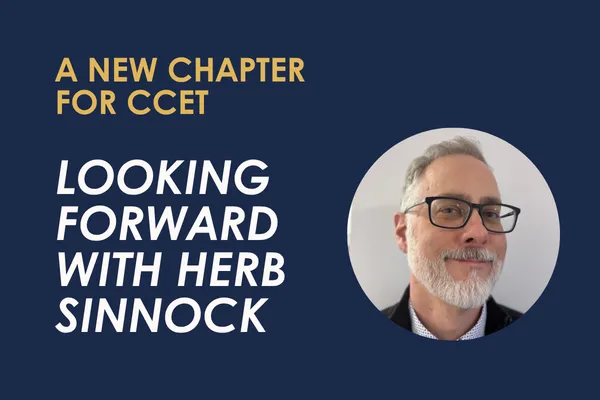
A New Chapter for CCET: Looking Foward with Herb Sinnock
As CCET launches a new brand and website, we also welcome a new person to the Executive Director's chair. We sat down with Herb Sinnock to talk about how he got here, what he's noticed in his first few months, and the version of CCET he's building toward.
This is a milestone moment for CCET. A new logo, a new website, and now a new Executive Director carrying the work forward across the Peel Region.
Herb comes to the role after three decades on the technical and operational side of the energy transition, and after helping found CCET itself. He knows this organization from the inside. He also knows what it took to build the foundation he's now standing on, and he's quick to give that credit where it's due.
We asked him where he sees CCET going next.
You've spent thirty years on the technical and operational side of energy. How did you end up leading CCET?
I didn't set out to become an executive director. My thirty years in the industry have really been on the technical and operational side of energy transitions.
Stuff like running the building construction of a district energy system at Sheridan College, three and a half kilometers of buried infrastructure at two campuses, or mobilizing forty-two million dollars in capital, getting these really significant greenhouse gas reductions across the campus a decade earlier than we expected to get there.
All of that stuff was proof for me. It showed me that this idea of doing transformation at scale isn't aspirational. It isn't just a slogan or a thing you say. It is an engineering and financing problem you can actually structure and solve. And I think, as that light bulb went off, I really got pulled into this idea that if I could help Brampton, I could help other municipalities.
And so, I helped bring Brampton's community energy and emissions reduction plan to life. And then having accomplished that, went on to help found CCET itself. So really, by the time I had joined CCET's board, I fully understood and believed in what this organization could be.
And I really believe in what CCET is doing and that it's the right solution. I watched the way that CCET's founding executive director began to build it, through the relationships, the community trust, building credibility with the municipalities we serve, and that foundation is huge.
It matters immensely to the stage we're in now. And then what pulled me into the executive director's role wasn't really an ambition to take that title. It was recognizing that CCET was now standing at the edge of this next phase where it could shift from the idea of demonstrating and foundation building into the actual act of transformation.
And as I reflected on the journey I've been through, I realized that really my whole career has been building those muscles that phase requires. Things like systems thinking and mobilizing capital and building stuff that didn't exist before. So, this was in some ways less a career move, and more like the work and I found each other.
What's stood out to you in your first couple of months?
There's a depth of trust CCET's already built in the region, with the municipal staff, with community organizations, with the partners who helped found us.
And a lot of that is not stuff you can immediately stand up. It takes a few years. And it's truly the product of real diligent work, that relationship building and being present in the community and showing up for events, drawing on that credibility of all the founders, and just standing up the organization in a way that it's recognized in the community.
And so, Tony, Gil, Laurie, the board, all those folks in the founding, they really didn't just start an organization. They actually got CCET to a point where it's got a seat at the table, and it's recognized across the entire region. So, it's really not a small thing. I just really want to acknowledge that it's super important that the foundation existed, and it's the reason I get to have this conversation at all about what's next.
And then I've also noticed that the trust that's been fostered in CCET is turning into something else, and I would just call that appetite. So over the last couple of months, I’ve had a lot of conversations with the board, the municipal partners, the community organizations we work with, and what I keep hearing from all of them is that people are really ready for CCET to lean in to do more.
And that's not just us being more visible and pitching ourselves more completely to the community, but really because people recognize that there's a solid foundation there, and they trust us, and they want us to carry more weight. So that's also what I've walked into.
We've launched a new brand and website. What does this next chapter mean to you, and what version of CCET are you building toward?
So I keep coming back to the raw numbers, the economics of this thing. When I did the math, it was a little bit back of the envelope, but something like 4.7 billion, with a B, dollars are spent by the regions, this is everyone in the community, just on energy, just on utilities.
And so you can imagine that something like 3.4 billion dollars, that's actually leaving the community. It's going to pipelines, it's going to oil sands, it's going to shale fields, it's going to transmission operators. It's not staying local. So that's the scale we're actually operating at.
To internalize that, we've got an opportunity at that scale. You can see that the model that prevails, what I might call the old model, the one that prevails consistently across jurisdictions of one homeowner at a time, one advisory conversation, doing one building, it doesn't scale. It's not going to get us there.
So this new era, to me, it's about matching an operating model to the size of that opportunity, of that amount of transition and transformation. And you can think of it as the difference between establishing programs and building a transformational platform, a transformational approach, operating now at scale.
So really, first chapter of CCET, if we reflect back, was about proving a model that we could have an intermediary operating in this municipal space at arm's length, that it could foster these relationships. It could be trusted to run the pilots. And that work is really fundamentally done, and it's been done really well.
And now the version of CCET that I'm really building towards is one where we're not just advising individual homeowners or individual businesses one at a time. We're now going to coordinate whole neighbourhoods, whole building portfolios, whole districts, even entire municipalities.
And we're going to think hard structurally about what it takes to retrofit sixty to eighty percent of homes rather than five percent. So it's fundamentally not just a bigger version of what we're doing, not just a simple matter of turn up the volume, run faster, or whatever else. This is a different operating model.
We've got to mobilize community relationships. It's not just a matter of connecting people to technical expertise and programs. It means now bringing private capital into the room, creating the pipelines, training and delivering and quality assurance, and not just distributing grant dollars to participants.
And that fundamentally should change the way CCET's partnering with the municipalities it's in, as really a fundamental delivery agent. Another way to think of it is understanding that CCET's like a conductor who's got the full score of this energy transition, and you've got all the other actors in there, the developers, the utilities, the homeowners, the municipalities, and they're playing their part, and they see their part, and they understand their part because that's what they're supposed to do.
But what we're supposed to do is help hold the entire picture and frame. It's not leaning in to do everyone else's job. We're just trying to make sure the whole thing plays in time and in tune, that it all makes sense, and it all goes where it needs to go.
So this chapter, it's a signal that CCET's moving from this organization as an intermediary to here's an organization that can really begin to deliver these bigger outcomes, this scale that we have to get to, to unlock that four point seven billion dollars.
Who do you want at the table for this next chapter? What does real partnership with CCET look like?
Well, everyone in this ecosystem's got a bit of the puzzle, but we should really zero in, because we can't just say everybody's got a part.
So we want elected officials and municipal staff to be willing and understand that there must be, from the top down, this institutional space for something new and different. It's not just being supportive in a principled idea, or shipping out grant money and support dollars, but willing to work in parallel with CCET and to put CCET's tools and ideas into planning documents and into procurement. But then also to recognize there are things that CCET should be running with that will advance both of our goals.
We'd want the financial institutions, the infrastructure investors who are excited about retrofit portfolios and district energy portfolios, and really view those as investable, great opportunities, so we need those partners in the mix.
And we also really want to see those energy services companies, the financial and technical companies who can deliver the actual on-the-ground transformation of a property, a building, a portfolio, and we want them working with us like long-term collaborators, so that they shouldn't just feel like a one-off vendor that we sent an opportunity to, but really legitimately a partner.
But then the partnerships that I'm going to care most about deepening are those ones with the community organizations. I'm talking about faith communities, tenant associations, cultural groups, and service clubs. These are more than outreach channels. These are the social infrastructure, the infrastructure of trust that's going to unlock the neighbourhood-level transformation we need and actually ensure that it's meeting the right objectives for those neighbourhoods.
This is a chance to begin transformation at the social level and then move it to the technical level. Because really the thing I've learned over the years, in working in transformations, whether in an institutional setting like Sheridan or at the municipal scale, is that the bottleneck in retrofits is never really about technology or financing. I mean, those are part of it, but ultimately it's whether people trust the message, the work, the approach, and the messenger themselves.
And we recognize that those community organizations already have that trust, and our job is really to work alongside them and with them, not around them. So that meaningful partnership, to me, is like mutual benefit that we've made explicitly clear.
So, this is not something we assume but actually have made clear that there's a benefit in both ways. And organizations that are partnering with us, bringing their own credibility to the table, and bringing this regional mandate that we've got, this technical capacity, the deep networks. And both things together should be treated like they're equally necessary for the transformation.
So, it's not CCET as this hub that everything reports into. It's CCET as a catalyst, a connective tissue, a bridge that makes the whole thing work and makes it all possible.
How do you describe CCET's role in the energy transition?
I keep coming back to this idea that CCET's a catalyst or a systems integrator. We're not really a service provider. There are a lot of organizations that do really good, focused work on delivery of programs. We've got utilities that run their incentive programs, municipalities that do great policy development, contractors who can do retrofits. We've got the energy services companies that do great work with businesses.
What's usually missing though is an organization that sees across all of that and coordinates that towards that shared outcome, holding the thing in the full frame, and that's the gap that CCET fills.
We're that organization that can sit between the municipality and its planning department and its goals, that developer's business plan, that utility's infrastructure roadmap, and really say, "This is how these pieces fit together, and here's what's got to happen next in order to unlock that."
District energy is a perfect example of that. We've already got, in several cases, developers, municipalities, a would-be thermal utility operator. They're around the table, but they're each looking at each other, waiting for the first one to move, and it's like a lockup. They're not yet moving, so someone's got to break that lock, and that's what we do.
I think CCET's role is to be that entity that makes the transformation we're talking about, which is huge, but to make it feel achievable instead of just aspirational or theoretical. To take that plan, the community energy and emissions reduction plan, and operationalize it, going neighbourhood by neighbourhood, building by building, until those energy commitments, those environmental commitments that the region's made aren't just a target on a page. They actually become tangible, and tractable in how things get done.
Welcome, Herb. We're glad you're here, and grateful for the foundation that makes this next chapter possible.
We are connecting Peel Region homeowners and communities to honest, independent guidance on the energy transition. If you're new here, explore our programs or book a free conversation with an Energy Coach to see where we can help.


