

A New Chapter for CCET: Looking Back with Tony Iacobelli
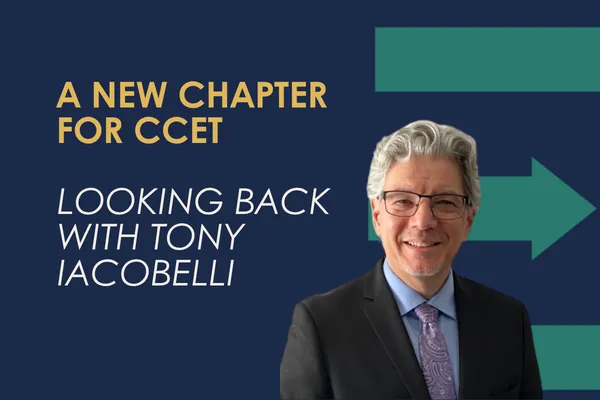
To mark the launch of our new brand and website, we sat down with Tony Iacobelli, CCET's founding Executive Director, who led the organization from June 2023 to March 2026. We asked him to reflect on where CCET came from, what the work has looked like on the ground, and what excites him about what comes next.
This is a milestone moment for CCET. A new logo, a new website, a renewed commitment to the people and communities we serve across Peel. Before we look forward, we wanted to look back.
Tony was the first person to sit in the Executive Director's chair. He helped shape the programs, the partnerships, and the perspective that the organization carries into this next chapter. We're grateful for his leadership, and grateful he agreed to share his reflections here.
Tony, can you start by introducing yourself and how CCET came to be?
Hi, I'm Tony Iacobelli. I'm the founding Executive Director for the Centre for Community Energy Transformation. I was in the position from June 2023 to March 2026.
CCET came about when the four municipalities that make up Peel Region, the three local municipalities and the Region, came together and created an arm's length agency to help the municipalities implement their climate action plans. The mandate is to accelerate an energy transition to a clean energy future.
I was drawn to this mandate, not only the energy transition, but in particular on-the-ground action, tangible action to implement climate action to reduce greenhouse gas emissions, working not only with the municipal partners, but in the community with community partners.
Why did the municipalities feel they needed an arm's length agency to do this work?
In urban areas, there's really two main sources for carbon emissions. Transportation is certainly one, and then buildings are another major source of carbon emissions.
Municipalities already have some legislative authority to implement or put in place transportation infrastructure. They can put in place the budgets for transit, for active transportation routes, for EV charging stations, for example. So there's already some legislative authority for that.
To work on reducing greenhouse gas emissions from buildings, however, municipalities can really only influence. It's through implementing, through interpretation of the building code or things like green standards, which often end up being voluntary rather than mandated.
So having an arm's length agency like CCET help really focus on decarbonizing buildings is absolutely critical in an area like the Region of Peel.
What are CCET's two main program areas?
CCET has two main program areas to work on decarbonizing buildings.
One is to accelerate home energy retrofits, and there's something like over 330,000 low-rise dwellings in Peel Region.
The other main program area is to work on advancing low-carbon district energy. District energy is where you connect buildings thermally, so with underground pipes that are connecting buildings. This has the benefit of reducing overall energy requirements because you're managing energy loads across multiple buildings, including apartment buildings or condos and office buildings and industry, and you can plug in various energy sources into a district energy system. It can be geo-exchange, it can be sanitary sewer heat exchange, it could be even waste heat from industries like from a glass factory or from a data centre, for example.
Zooming out: the energy transition is a big concept. How do you describe what's actually happening right now?
The energy transition is underway. We see this mostly in the form of larger scale solar PV, solar photovoltaic, or wind energy projects being plugged into electricity grids. But people are retrofitting their homes, businesses are becoming more efficient.
One of CCET's clearest commitments is making sure the energy transition is inclusive. Why has that been such a focus?
One of the things that CCET can work on, and we've made this a focus for CCET's work, is to ensure that everyone can participate in the energy transition. It shouldn't just be for people who have the disposable income to improve and upgrade their homes.
This is where a project like district energy is very useful, because by being able to connect condo buildings and apartment buildings through thermal networks with other buildings, you have the opportunity to not just help homeowners, but help people who are renting their units, you know, renting where they live, and be part of the energy transition.
What about for individual homeowners? How should they be thinking about retrofits?
The other area for CCET to emphasize in undertaking retrofits is not just to chase one or two retrofits because there are rebates available for a particular home upgrade, whether it's replacing your furnace with a heat pump or putting in new windows, but to think about your house and the journey to electrification, or the journey to net zero.
And then also consider that every building can be generating electricity, particularly renewable electricity, into the grid, particularly with solar photovoltaic.
Tell me more about that. The idea that homes can generate energy, not just use it.
This kind of deployment of solar is particularly interesting because then you build what is called a virtual power plant in the community, and utilities are seeing the benefit of this kind of distributed energy resources in the community essentially becoming a virtual power plant.
So not only can you participate in the energy transition by creating more energy efficient homes, you can also think about actually creating renewable energy and feeding that into the grid, not just offsetting your own energy use.
What do you see as the bigger ripple effect of all this work in the region?
The energy transition is pretty exciting. It's really an economic development opportunity as well.
Saving money keeps money in the community, which can be repurposed for other uses, as well as hiring people to deploy the various technologies, whether it's heat pumps or solar photovoltaic or district energy systems, as well as monitoring and managing the energy systems to be more efficient.
Any final thoughts as you step away from the founding ED role?
It's exciting times, and I look forward to seeing great things from CCET in the future.
Thank you, Tony, for everything you built. The foundation you laid is what makes this next chapter possible.
As we launch our new brand and website, our work continues: connecting Peel Region homeowners and communities to honest, independent guidance on the energy transition. If you're new here, explore our programs or book a free conversation with an Energy Coach to see where we can help.


