




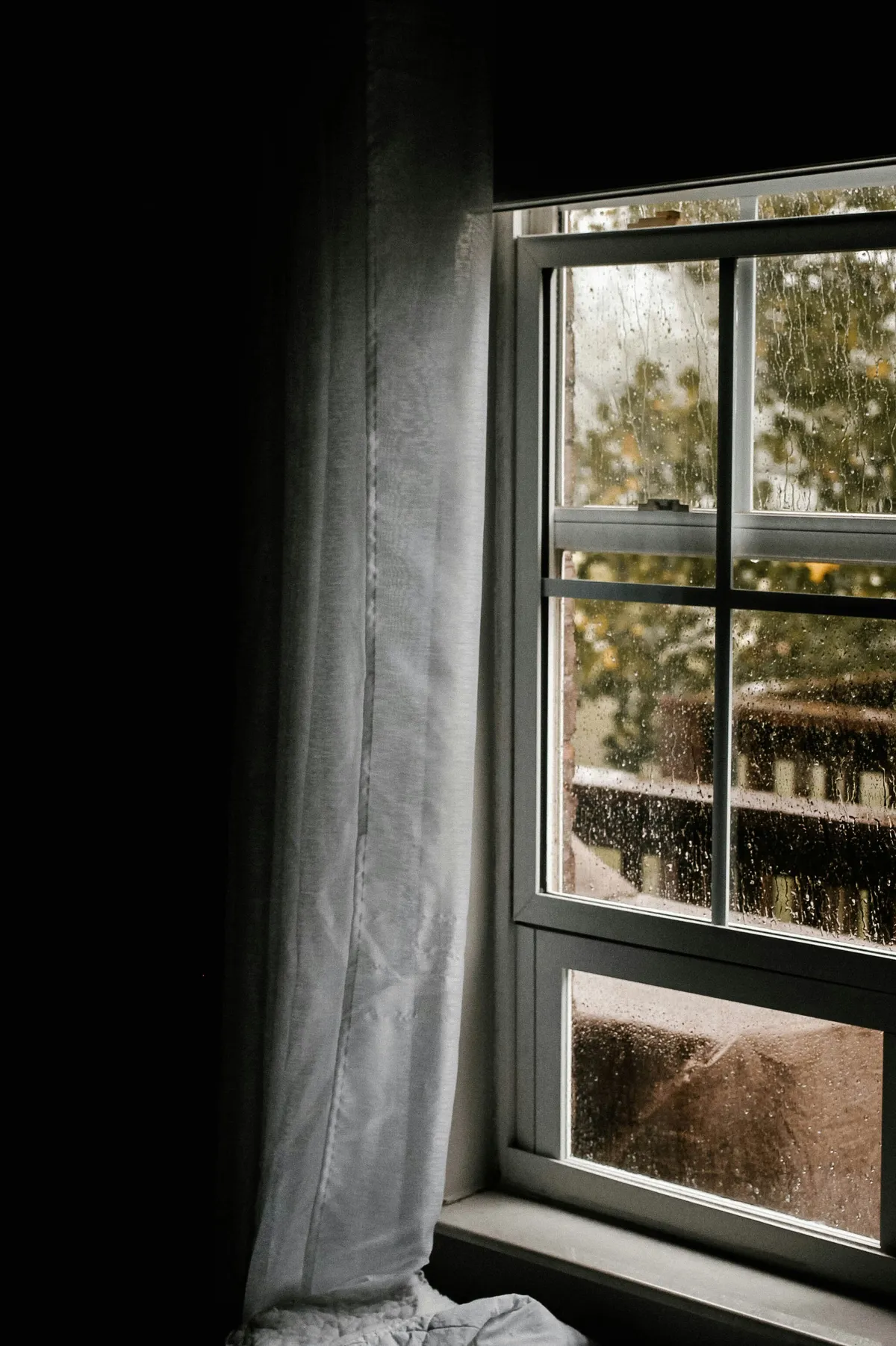
Why is there condensation on my windows?
Let's say you open the blinds on a cold morning and there's water sitting along the bottom of the glass, maybe even a thin line of ice on the frame. The first thing that crosses your mind is, "Why is there condensation on my windows?" and right behind it, whether you need new ones. Once the cold sets in, those are two of the questions our team hears most from homeowners in Brampton, Mississauga and Caledon.
The short answer to "Why is there condensation on my windows?" is that condensation forms when warm, moist air inside your home hits a cold surface, and in winter your windows are usually the coldest surface in the room. What I tell people on coaching calls is that the fix usually starts with the moisture and the air flow, long before we need to talk about replacing anything.
In this post I'll walk you through what your windows are telling you, what's worth trying first and when it actually makes sense to replace your windows. If you want windows that stay clear all winter without guessing at what to fix, book a call with an Energy Coach and we'll start with what's causing it in your home.
Why does condensation form on windows?
Think about a cold glass of water on a hot summer day. Within a few minutes the outside of the glass is wet, and none of that water came from inside it. The air touching the glass cooled down, and cooler air can't hold as much moisture as warm air, so the extra moisture had to go somewhere and it settled on the glass. Your windows in winter work the same way, with the cold on the outside and the warm, moist air of your living room on the inside.
Natural Resources Canada notes that the risk goes up as the weather gets colder or the air inside gets more humid, and if it's cold enough, that moisture can even freeze into frost. That's why you'll usually see the most of it on the coldest mornings.
A lot of that moisture comes from just living in your home. Every shower, pot of pasta, load of laundry and houseplant adds a little, and so does everyone breathing in the house. Homes today are also built tighter than they used to be. An older, draftier house lost a lot of its moisture through all those gaps along with its heat, but in a tighter home moisture can build up inside, especially in winter when the windows stay shut.
Where is the water? What your windows are telling you
When I'm helping someone figure this out on a coaching call, the first thing I ask is where exactly they're seeing the water, because each spot points to something different.
Where you see it | What it usually means | What I'd suggest |
|---|---|---|
On the inside of the glass | There's more moisture in your air than that cold glass can handle | Check your humidity and work through the steps below |
On the frame, the sash or near the seals | Cold air is probably sneaking in around the window and chilling those spots | Look for drafts, then caulk and weatherstrip |
Between the panes | The seal on the glass unit has failed | Replace the sealed glass unit or the window (NRCan) |
On the outside of the glass, around sunrise | High-performance glass doing its job after a cool, calm, humid night (NRCan) | Nothing to fix |
The last two confuse people the most, so here's what's going on with each.
Most windows today are a sealed glass unit, which means two or three panes with a sealed space between them, often filled with an insulating gas. When that seal fails, moist air sneaks into the gap and fogs it from the inside, and no amount of wiping will clear it. That's really the only case on this list where the window itself needs work.
Condensation on the outside tends to surprise people even more, because it usually shows up on newer windows. Many of them have a low-emissivity (low-e) coating, a very thin layer on the glass that reflects heat back into your room. Your heat stays inside where you want it, so the outer pane stays close to the outdoor temperature, and on a cool, calm, humid night it collects dew the same way your lawn does.
If you want to know which of these is behind the water on your windows, that's where we'd start on a call: going through what you're seeing and narrowing it down for your home. Talk it through with an Energy Coach.
Is condensation on windows bad?
A bit of fog along the bottom of the glass on the coldest mornings is pretty normal, and I wouldn't worry about it. When it's heavy, or it hangs around most of the day, that's when I'd start paying attention. NRCan points to dampness, mould and heavy condensation on windows as signs there's too much moisture in a home, and over time that moisture can affect your air quality and even the structure of the house.
The part most people never see is what happens after the water runs down the glass. It soaks into the sill and the wood around the frame, and when that happens day after day all winter, those materials stay damp long enough for mould and rot to set in. Once it's been going on for a while, it tends to look like this:
water pooling on the sill, or condensation that's still there in the afternoon
peeling paint, stains or soft spots on the sills and frames
damaged drywall under the window
a musty smell, or mould on the walls, the drapes or inside closets
Canada Mortgage and Housing Corporation (CMHC) lists these same signs in its homeowner guide, Moisture and Air: Problems and Remedies. If any of them sound familiar, it's a lot easier to deal with now than after it's turned into a bigger repair.
What should the humidity be in my house in winter?
Before you change anything, I'd measure. A hygrometer is a small, inexpensive gadget you can pick up at most hardware stores, and it tells you the relative humidity in the room. Relative humidity is how much moisture the air is holding compared to the most it could hold at that temperature, so a reading of 40 per cent means the air is a little less than half full.
Health Canada suggests keeping indoor humidity around 30 to 40 per cent in winter and no higher than 50 per cent in summer.
CMHC says it shouldn't go over 50 per cent during the heating season, and on the really cold days you may need to bring it down to 30 per cent or lower to keep your windows clear.
The target moves with the weather because your glass does. As it gets colder outside, the inside pane gets colder too, and the air right next to it hits its limit sooner, so humidity that was fine in November can fog up your windows in a January cold snap. CMHC also notes that more energy-efficient windows can handle higher humidity before they fog up, since their inside pane stays warmer, which is part of why older windows tend to be the first to show it.
If your hygrometer says you're in range and your windows are still wet, something else is probably going on, like air leaking in around the frame or a ventilation problem. If you want windows that stay clear, that's what we'd focus on next, looking at how air and moisture move through your whole home on a call with an Energy Coach.
How to stop condensation on windows: what to try first
Almost everything I'd suggest here costs very little, if anything. Each step either puts less moisture into the air or keeps your glass a little warmer, and they all come from NRCan's guidance on condensation and reducing moisture at home.
Use your kitchen and bathroom fans while you cook and shower, and leave them running for a bit after. A hot shower puts a surprising amount of moisture into the air, and the fan is how it gets outside, so check that yours actually vents outdoors.
Turn down the humidifier on your furnace, if you have one, since it may be adding more moisture than your home needs once the weather turns cold.
Make sure your dryer vents outside.
Keep air moving across the glass. Moving air keeps the glass a little warmer, which is why so many homes have heat vents right under the windows. Open your blinds and drapes during the day, pull furniture back from the window and keep those vents clear.
Turn on your heat recovery ventilator (HRV) if your home has one. An HRV swaps stale, moist air from inside for fresh air from outside, and it runs the two streams past each other so the air leaving your home warms up the air coming in.
Make a little less moisture by putting lids on pots, keeping showers shorter and storing firewood outside.
Seal up drafts around windows and doors with fresh caulking and new weatherstripping. On a really drafty window, the clear plastic heat-shrink film you put up for the winter can help too.
Keep water out of the basement by fixing leaks, making sure the ground slopes away from your foundation and checking that your eavestroughs carry water away from the house.
Give it a week or two of cold weather and keep an eye on your hygrometer. If the condensation starts to ease up, you're on the right track. Small changes can go further than you'd think, especially in older homes.
How your appliances affect moisture
Some of the equipment in your home adds moisture to the air and some of it takes moisture away. If you've made changes recently and suddenly noticed more condensation, this is one of the first places I'd look. A few to keep in mind:
Ventless dryers, like condensing and heat pump models, can make the air around them more humid, so empty the collection pan often and give the dryer room to breathe.
Water vapour electric fireplaces create their flame effect with a fine mist, and that mist adds humidity to the room.
Heat pump water heaters work a bit like a dehumidifier. They pull heat out of the surrounding air to warm your water, and as that air cools, moisture comes out of it and drains away.
Portable window heat pumps take moisture out of the air too.
If you swap a gas water heater, dryer or fireplace for an electric one, you can usually seal up the old vent or chimney, which means fewer drafts and a home that holds onto its heat. Just keep in mind that the tighter your home gets, the more ventilation matters. The goal is a home that holds heat well and still breathes, which is where an HRV comes in.
Do I need new windows or doors?
If you've worked through the steps above and your humidity is where it should be, it might be time to look at the windows or doors themselves. These are the things that would point me in that direction:
fog or moisture between the panes that never clears
frames or sills that are soft, rotting or badly stained
drafts you can still feel after new caulking and weatherstripping
condensation that keeps coming back even when your humidity is low
doors or windows that have warped, or don't close and lock the way they should
New windows can help. NRCan notes that Energy Star-certified windows, doors and skylights are more energy efficient and get less condensation than standard models. They're also one of the bigger investments you can make in your home, so I'd want you to spend that money knowing it will solve the problem. Lower-cost fixes, like sealing around vent pipes, replacing the weatherstripping on your doors and adding attic insulation, can make a real difference to how comfortable your home feels and what you pay to heat it.
Questions to ask a window or door installer
Are these windows Energy Star certified?
Do they have the features NRCan links to better performance, like triple glazing, low-e coatings, gas between the panes, insulated spacers and insulated frames?
How will you seal and insulate the gap between the new frame and my wall?
What does the warranty cover if a seal fails, and for how long?
Do I need a home energy assessment before you start so I can still get the rebate?
If those features sound like a lot of jargon, they all do the same job. Each one slows down how fast heat moves through the window, which keeps the inside pane warmer and makes it much harder for condensation to form.
I hear this all the time on coaching calls: one contractor tells you to replace the windows, another says to start with insulation, and after hours of research you're more confused than when you started. If you want to put your money into the fix that actually solves the problem, we'd go through the quotes you have and help you ask the right questions so you can choose with confidence. We don't sell equipment or do installation, so the only thing we're trying to do is help you make the right call for your home. Get a second opinion from an Energy Coach.
Home energy assessments and rebates for windows and doors
If you're dealing with condensation every winter, I'd recommend a home energy assessment as your next step. A registered energy advisor goes through your whole home and looks for the changes that will do the most for your insulation and air quality, and they can often catch hidden moisture problems before they get bigger.
An assessment is usually where rebates start, too. Ontario's Home Renovation Savings program, run by Enbridge Gas and Save on Energy, currently offers:
Windows and doors: $100 per rough opening for Energy Star-certified models, as long as you replace at least three windows, or one door, skylight or sliding door
Air sealing: up to $250
Attic insulation: up to $1,500
Home energy assessments: a $600 rebate once you finish the program
A $500 bonus when you complete three qualifying upgrades
The part I see people miss most often, and one of the first things we cover on an energy coaching call, is that the first assessment has to happen before you start any work. After that you complete at least two upgrades, then book a follow-up assessment with the same energy advisor. The program is open to homeowners in detached, semi-detached, row and townhomes, and mobile homes on a permanent foundation, with a few conditions depending on how you heat your home, so check the program page for the details.
The program also warns that scammers are setting up fake websites and pretending to be contractors, so stick with the approved service organizations listed on the official site.
Rebates get confusing fast, and the order you do things in matters more than most people expect. If you want to get the most back on your upgrades, we'd focus on what you could qualify for and how to line up the work so nothing gets missed. Book a call with an Energy Coach.
If the upgrades your home needs feel out of reach
Some households in Peel can get a full energy audit and select upgrades done through rebates, incentives and options with no upfront cost. If that sounds like it could help your home, bring it up when you talk with an Energy Coach and we'll help you find out if your home qualifies.
Frequently asked questions about window condensation
Is condensation on windows normal in winter?
A little fog on the coldest mornings is pretty common. If water is pooling on the sill or the condensation is still there in the afternoon, your home is holding more moisture than it can handle.
Why is there condensation on the inside of my windows?
Warm, moist air in your home is hitting cold glass and cooling down past the point where it can hold all its moisture. High humidity, poor air flow near the window and drafts around the frame all make that more likely.
Why is there condensation between my window panes?
The seal on the glass unit has broken and moist air has gotten into the space between the panes. That's the one case where the window itself needs to be repaired or replaced.
Why is there condensation on the outside of my new windows?
Newer, high-performance glass keeps your heat inside, so the outer pane stays cool. After a cool, calm, humid night you might see dew on the outside around sunrise, and that's normal.
What should the humidity be in my house in winter?
Health Canada suggests around 30 to 40 per cent. On very cold days, CMHC says you may need to bring it down to 30 per cent or lower to keep your windows clear.
Will new windows stop condensation?
Energy-efficient windows do get less condensation, but they won't fix high humidity in the rest of the house, so I'd always start with your humidity, ventilation and air sealing.
Do I need a home energy assessment to get a rebate on windows?
For Ontario's Home Renovation Savings program, yes, and it has to happen before any work begins.
Who can help me figure out what my home needs?
If you live in Brampton, Mississauga or Caledon, you can book a call with an independent Energy Coach. Your coach will meet you where you are, whether you've just started noticing the condensation or you already have a quote in hand.
Talk it through with an Energy Coach
Most of the time, condensation on your windows is your home trying to tell you something, and it's rarely an automatic sign you need new ones. Every home is different, though, and there's often more than one thing going on at once.
If you want to get through the winter with clear windows and a home that feels comfortable, an Energy Coach will talk with you about what's bugging you and what you're hoping to improve, then help you sort out what your windows are telling you, what to try first and whether an assessment or an upgrade makes sense. You'll leave with a clear next step, and there's no sales pitch at the end.
Book a call with an Energy Coach
About the author
Gil Amdurski is the lead of energy retrofits at the Centre for Community Energy Transformation (CCET). He's building a residential energy retrofit hub to help homeowners use less energy and cut greenhouse gas emissions. He designs programs that give people practical support and equitable access to energy efficiency, and he works with partners to track grants and incentives so the whole process is easier for homeowners.
Originally from Toronto, Gil is a graduate of George Brown College and the University of Toronto. Since 2016, he has also worked in teaching and research, as a professor at George Brown College and a technical co-ordinator with Toronto and Region Conservation Authority (TRCA). In 2015, he founded RE•measure, a consulting firm that helps people and businesses become more sustainable.
References
Canada Mortgage and Housing Corporation. (2008). Moisture and air: Householder's guide, problems and remedies (Rev. ed.). https://publications.gc.ca/site/eng/9.694907/publication.html
Enbridge Gas & Save on Energy. (n.d.). Energy assessment required upgrades. Home Renovation Savings. Retrieved November 2, 2026, from https://www.homerenovationsavings.ca/with-assessment
Health Canada. (2011, July 5). Mould: Simple steps for preventing and removing mould in your home [Video transcript]. Government of Canada. https://www.canada.ca/en/health-canada/news/media-room/video-gallery/mould-simple-steps-preventing-removing-mould-your-home.html
McDiarmid, H. (2026). Canada's home electrification toolkit (Version 1.4). Building Decarbonization Alliance. https://buildingdecarbonization.ca/canadas-home-electrification-toolkit
Natural Resources Canada. (2025a, January 16). Condensation. Government of Canada. https://natural-resources.canada.ca/energy-efficiency/product-energy-ratings/condensation
Natural Resources Canada. (2025b, March 21). Humidity levels: Cooling and ventilating equipment. Government of Canada. https://natural-resources.canada.ca/energy-efficiency/energy-star/products/list-certified-products/humidity-levels-cooling-ventilating-equipment


